
Table of Contents
Introduction: A Calm That’s Unsettling
At first glance, a calm stock market sounds like good news. No panic. No wild swings. No sudden crashes. But for India’s vast community of derivatives traders, this calm has become a challenge rather than a comfort.
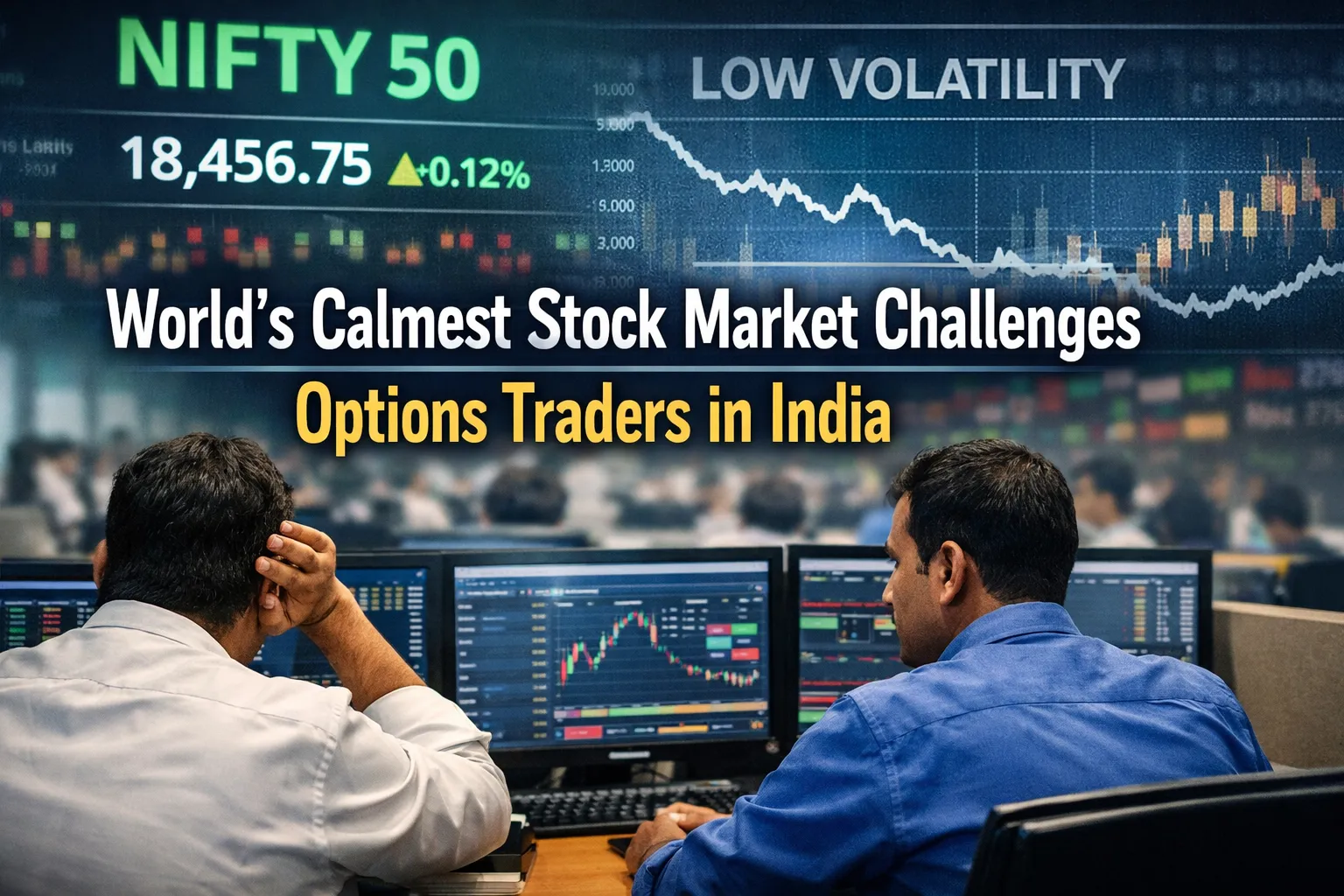
Despite geopolitical flare-ups, global equity selloffs, and persistent uncertainty across markets, the NSE Nifty 50 has barely moved for months. The result? India is now home to what many are calling the world’s calmest major stock market.
For options traders, that serenity comes at a cost. Volatility—the very fuel that drives options pricing—has all but dried up.
Why India’s Stock Market Feels Unusually Quiet
Global markets haven’t exactly been peaceful. Wars, trade tensions, interest rate uncertainty, and tech-sector corrections have rattled investors elsewhere. Yet India’s benchmark index continues to drift sideways.
One key reason is the overwhelming presence of domestic capital. Systematic investment plans (SIPs), pension funds, and local institutions have steadily absorbed selling pressure, smoothing out shocks that might otherwise cause sharp moves.
Meanwhile, India’s volatility gauge has slipped to historic lows, signaling muted expectations for future price swings. In simple terms, traders aren’t expecting fireworks anytime soon.
Volatility: The Lifeblood of Options Trading
Options trading thrives on uncertainty. When markets swing, investors pay higher premiums to hedge risk. When prices barely move, option premiums shrink.
That’s exactly what’s happening now.
India runs the largest options market in the world by volume, but volume alone doesn’t guarantee profits. With volatility crushed, traditional strategies—especially option selling—have become far less rewarding. Returns are thinner. Risks feel asymmetrical. And mistakes hurt more.
A trader summed it up simply: “Low volatility feels safe, until it stops paying the bills.”
How SEBI’s Derivatives Curbs Changed the Game
A major turning point came when the Securities and Exchange Board of India (SEBI) stepped in to rein in speculative excesses.
Concerned about heavy retail losses, the regulator:
- Scrapped several popular weekly options
- Tightened rules around short-dated contracts
- Reduced products that amplified intraday swings
These steps worked. Speculation cooled. So did volatility.
Notional turnover in derivatives has dropped sharply compared to last year—the first sustained decline since 2017. Less churn in derivatives has spilled over into the cash market, reinforcing stability in the Nifty 50.
Domestic Money vs Foreign Flows
Another quiet but powerful shift is happening beneath the surface.
Foreign investors have pulled out aggressively, with billions of dollars exiting Indian equities amid global trade tensions and limited exposure to the AI boom. At the same time, domestic institutions have stepped up like never before.
Local funds have poured record sums into Indian stocks, overtaking foreign investors as the market’s largest owners for the first time in more than a decade. Data from Prime Database shows domestic inflows surpassing $80 billion in a single year.
This steady local buying acts like a shock absorber. When prices dip, domestic money steps in. When global sentiment worsens, India barely flinches.
Nifty 50’s Long Calm Stretch: What the Numbers Say
The numbers tell a striking story:
- The Nifty 50 has moved less than 1.5% for over 150 consecutive sessions
- Three-month realized volatility has fallen near 8, among the lowest globally
- India’s volatility gauge closed at an all-time low recently
Compared to peers, India now looks unusually stable—almost eerily so.
Ironically, that stability hasn’t translated into outsized equity returns. While global indices surged, India’s benchmark posted modest gains in comparison.
Valuations, Returns, and the Cost of Stability
Valuation is another piece of the puzzle.
India’s benchmark trades at a premium—around 20 times forward earnings—well above broader emerging markets. According to data compiled by Bloomberg, this rich valuation limits upside even when sentiment improves.
So investors face a paradox:
- Low volatility
- Moderate returns
- High valuations
For options traders, it’s a tough environment. Premiums are low, directional moves are scarce, and patience is constantly tested.
How Options Traders Are Adapting
Traders aren’t giving up. They’re adjusting.
Some desks are:
- Taking higher risk to chase returns
- Moving toward complex, multi-leg strategies
- Exploring longer-dated options
- Diversifying into other asset classes
But adaptation comes with its own dangers. Increasing risk in a low-volatility market can backfire fast if volatility suddenly spikes.
As one fund manager noted, volatility never disappears forever. It only sleeps.
What Comes Next for India’s Derivatives Market
Most professionals agree this calm won’t last indefinitely. Volatility tends to be cyclical. When it returns, strategies will shift again.
Potential triggers include:
- Global risk events
- Domestic political developments
- Earnings surprises
- Regulatory changes
For now, India’s market stands out as an anomaly—stable, liquid, and remarkably composed. But for traders whose livelihoods depend on movement, the challenge is real.
Conclusion: Calm Isn’t Always Comfortable
India’s stock market has earned an unusual title: the world’s calmest major equity market. That calm reflects stronger domestic participation, tighter regulation, and a maturing ecosystem.
Yet for options traders, it’s forcing a painful rethink. Traditional volatility-driven strategies no longer deliver as they once did. Profits are harder to come by. Risk management matters more than ever.
Calm can be powerful. But in markets, too much calm can be just as unsettling as chaos.
FAQs
Strong domestic inflows, reduced speculative derivatives trading, and regulatory curbs have absorbed global shocks and dampened volatility.
Low volatility reduces option premiums, making selling strategies less profitable and limiting trading opportunities.
Yes. By cutting weekly options and speculative products, SEBI reduced intraday swings and overall derivatives activity.
Yes, but domestic institutions now dominate ownership, cushioning the market against foreign outflows.
Most experts believe so. Volatility is cyclical, and current levels are considered unsustainably low.


