
Table of Contents
Introduction to the 357 Trading Strategy
Every trader, at some point, searches for a strategy that feels simple, logical, and repeatable. Something that doesn’t rely on guesswork or complicated indicators. That’s where the 357 trading strategy quietly earns its reputation.
I remember speaking to a trader who said, “The moment I stopped chasing fancy indicators and focused on structure, my trades made sense.” The 357 strategy is built on that exact mindset.
It’s clean.
It’s rule-based.
And it focuses on trend, momentum, and confirmation.
Also Read: Gold vs Silver: Which metal is poised to deliver higher return in year 2026?
What Is the 357 Trading Strategy?
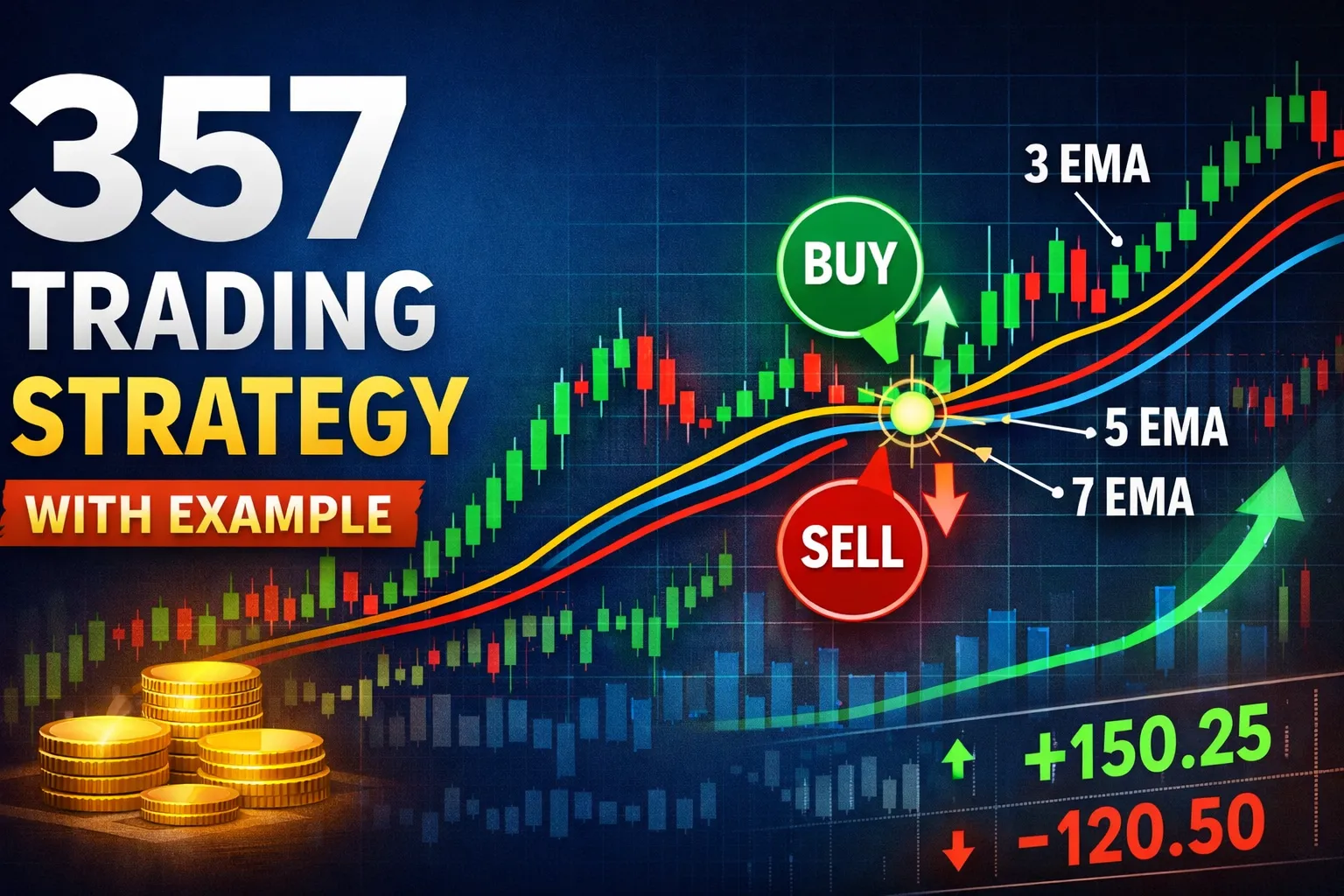
The 357 trading strategy is a technical analysis–based trading method that uses three moving averages—3-period, 5-period, and 7-period—to identify short-term trend direction and entry opportunities.
The idea is straightforward:
- 3 EMA → Immediate price reaction
- 5 EMA → Short-term momentum
- 7 EMA → Minor trend confirmation
When these averages align in a specific order, they signal a high-probability trade setup.
Simple numbers. Clear logic.
The Logic Behind the Numbers 3-5-7
You might wonder, why 3, 5, and 7?
These are odd numbers, which respond faster to price changes. The smaller the moving average, the quicker it reacts.
- 3 EMA reacts almost instantly
- 5 EMA smooths short-term noise
- 7 EMA provides stability
When price is healthy and trending, these three averages naturally stack together. That stacking is what traders watch.
No stacking. No trade.
Also Read: How to Practice Trading Without Losing Money (Paper Trading Guide)
Indicators Used in the 357 Trading Strategy
The beauty of this strategy is that it doesn’t overload your chart.
You’ll need:
- Exponential Moving Average (EMA) 3
- Exponential Moving Average (EMA) 5
- Exponential Moving Average (EMA) 7
- Candlestick chart (any timeframe)
Optional confirmations:
- RSI (14)
- Volume indicator
That’s it. Clean charts help you think clearly.
Market Conditions Where 357 Strategy Works Best
The 357 trading strategy performs best in:
- Trending markets
- High-liquidity instruments (stocks, indices, forex, crypto)
- Intraday and short-term swing setups
It struggles in sideways or choppy markets, where moving averages keep crossing back and forth.
One trader once joked, “If the market is confused, the EMAs will argue all day.” And he wasn’t wrong.
Step-by-Step Rules of the 357 Trading Strategy
Buy Setup Rules
- 3 EMA above 5 EMA
- 5 EMA above 7 EMA
- All three EMAs sloping upward
- Price closes above all EMAs
- Entry after a small pullback or strong bullish candle
Sell Setup Rules
- 3 EMA below 5 EMA
- 5 EMA below 7 EMA
- All three EMAs sloping downward
- Price closes below all EMAs
- Entry after pullback or strong bearish candle
No alignment = no trade. Period.
357 Trading Strategy with Example
Let’s break this down with a realistic intraday example.
Example: Buy Trade on NIFTY (5-Minute Chart)
Imagine NIFTY is trading at 19,450.
- The 3 EMA crosses above the 5 EMA
- Shortly after, 5 EMA crosses above 7 EMA
- All three EMAs start moving upward, neatly stacked
- A bullish candle closes above all three EMAs
This is your signal.
You wait. No rushing.
Next candle forms a small pullback, touching the 5 EMA, but closes bullish again.
Entry
- Buy above the high of the bullish pullback candle
Stop Loss
- Below the recent swing low or below the 7 EMA
Target
- 1:2 risk-reward
- Or trail stop loss using the 5 EMA
In many cases, price respects the EMAs beautifully. When it breaks below them decisively, you exit.
Calm trade. Logical exit.
Also Read: Stock Market Course With Certification in Delhi: Does It Really Matter?
Risk Management in the 357 Strategy
No strategy works without discipline.
Risk rules you’ll need:
- Risk only 1–2% per trade
- Fixed stop loss is mandatory
- Avoid overtrading during sideways markets
Remember, even the best setups fail sometimes. That’s normal.
Survival first. Profits follow.
Common Mistakes Traders Make
- Trading every EMA crossover
- Ignoring higher-timeframe trend
- Using the strategy in low-volume stocks
- Removing stop loss too early
- Over-optimizing settings
The strategy is simple. Overthinking ruins it.
Pros and Cons of the 357 Trading Strategy
Pros
- Easy to learn
- Works well for intraday traders
- Clean charts
- Rule-based entries
Cons
- Not effective in sideways markets
- Requires patience
- Small stop losses can be hit frequently
Every strategy has a trade-off. This one rewards discipline.
Is the 357 Trading Strategy Suitable for Beginners?
Yes, absolutely.
Beginners benefit because:
- Rules are clear
- Indicators are minimal
- Entries are visual
- Emotional trading reduces
However, paper trading is essential before risking real money.
Practice first. Always.
Final Thoughts
The 357 trading strategy with example shows us one important truth:
Trading doesn’t need to be complicated to be effective.
This strategy won’t make you rich overnight. But it can make you consistent. And in trading, consistency beats excitement every single time.
If you respect trends, manage risk, and wait for confirmation, the 357 strategy can quietly become part of your trading routine.
Simple works. Often best.
Lean the 3-5-7 strategy with DICC stock market course in Delhi and start your financial journey.
Frequently Asked Questions (FAQs)
Yes, when used with proper risk management and in trending markets, it can be consistently profitable.
It works well on 5-minute, 15-minute, and 30-minute charts, especially for intraday trading.
Yes, many traders use it to time entries in index options like NIFTY and BANKNIFTY.
Yes, as long as liquidity is high and trends are clear.
Initially, no. Master the core rules first. Add confirmations later if needed.


I really like how the 357 strategy simplifies intraday trading by focusing on clear entry and exit rules. The emphasis on understanding when the strategy works best in different market conditions is something I hadn’t considered before. Looking forward to experimenting with it on my own charts!